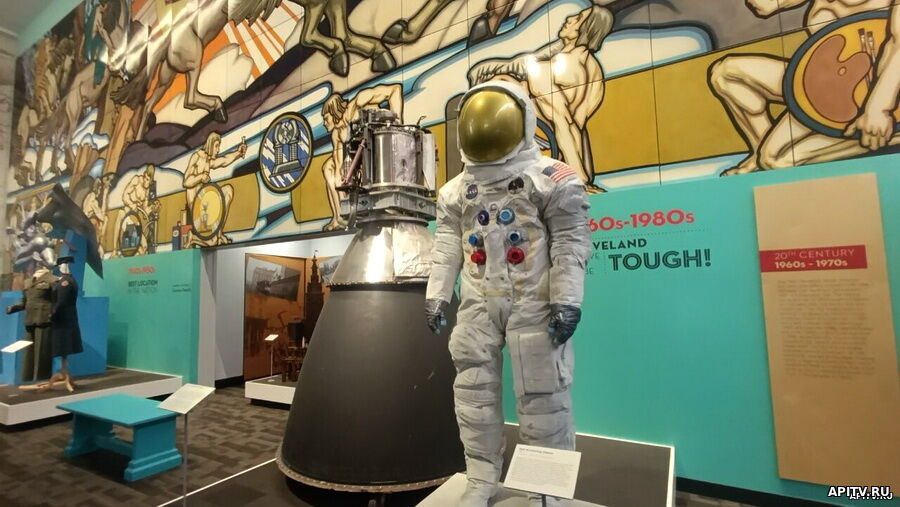
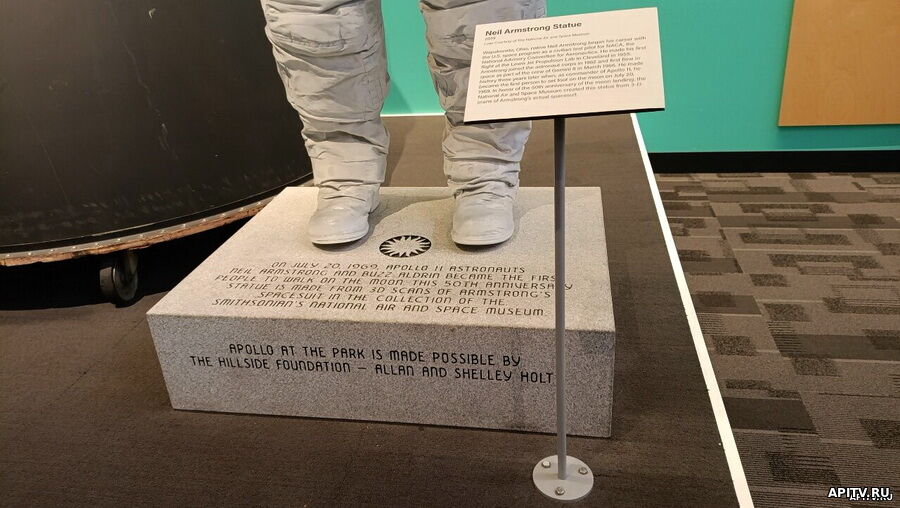
Cleveland Historical Center holds two of the most significant artifacts in the history of flight: the statue of Neil Armstrong and the Lunar Module Descent Engine (LMDE). The Statue: A Face from the StarsThe bronze statue, unveiled in 2019, is not a generic tribute. It is a digital resurrection. Created by the Smithsonian's National Air and Space Museum to honor the 50th anniversary of the Moon landing, the statue was sculpted using precise 3-D scans of Armstrong's actual spacesuit. Standing before it, you are not looking at an artist's impression; you are looking at the exact dimensions of the suit that touched the lunar dust on July 20, 1969. Neil Armstrong was a native of Wapakoneta, Ohio, but his journey into the void began here, in Cleveland. His first flight for the U.S. Space Program was not in Florida or Texas, but at the Lewis Propulsion Lab (now NASA Glenn) in 1955. Before he was an astronaut, he was a civilian test pilot for NACA — the National Advisory Committee for Aeronautics — pushing the limits of the unknown right here on the shores of Lake Erie.
The Engine: Cleveland’s Throttle to the Moon If Armstrong was the face of Apollo 11, the Lunar Module Descent Engine (LMDE) was its muscle. And it, too, has deep Cleveland roots. The engine sits in the museum as a piece of raw engineering — a complex tangle of valves, wiring, and a massive nozzle. It looks less like a rocket and more like a high-tech showerhead, which is exactly what made it revolutionary. When the Apollo program began, a variable-throttle rocket engine did not exist. To land on the Moon, you needed an engine that could whisper and roar — one that could slow a falling craft from orbital speed to a gentle touchdown. Several aerospace giants tried to invent it. The contract went to Space Technology Laboratories, a subsidiary of Cleveland-based TRW Inc. The secret was the pintle injector. Unlike traditional spray nozzles, this design allowed the engine to be throttled from 10% to 100% thrust, a feat of engineering that had never been flown before.
My TakeawayStanding in the Cleveland History Center, looking at the engine and then at the statue, the scale of the achievement hit me differently than it ever did in a textbook. We often think of the Moon landing as a purely Floridian or Texan story (Cape Canaveral, Houston). But the statue of the test pilot from Wapakoneta and the throttle engine from a Cleveland company tell a different truth: The Steel Belt didn't just build cars and steel; it built the stairway to the stars. As I left the museum, the words of Armstrong’s famous transmission echoed with a new weight. "One small step..." was made possible by a giant leap of engineering born right here, in the shadows of the factories I write about. David Polyakov (Special Correspondent for API TV from Cleveland, Ohio, USA) MORE: Sherman on Fifth Avenue: Triumph and the Shadow of the Civil War Odyssey of the Rust Belt: A Visit to Barons Bus Greyhound Lines: How I Swapped a Plane for an Intercity Bus First night in New York: not on Broadway, but on Busway White Among Blacks, Rich Among Poor: Survival in One of America's Dangerous Cities JFK — Manhattan: My First Steps in the USA Rockefeller Center: The Steel Flower of the Great Depression Cleveland: Where an Empire Was Born. The Story of Standard Oil and John D. Rockefeller Akron, "All-America City 2025": One Year After the Triumph Древние люди из Сунгиря. Экспедиция Андрея Полякова «По Пути Афанасия Никитина» #ДавидПоляков #USA #Clevelend #CIP #наука #Экспедиция #АндрейПоляков #APITV #ЭкспедицияАндреяПолякова #Путешествия #Туризм #Авто | |
|
| |
| Просмотров: 12260 | |