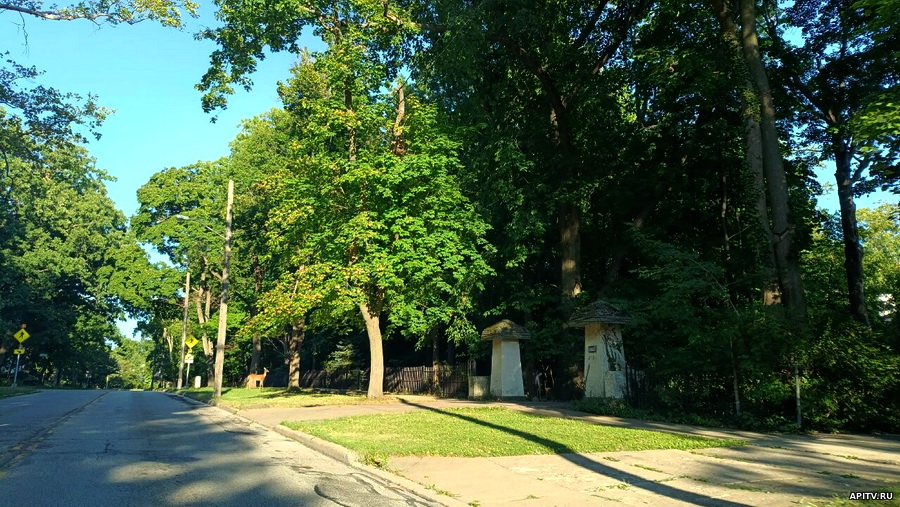
If Cleveland is the gritty, industrial heart of the Rust Belt, then Shaker Heights is its polished, green soul. As I traveled through the region, this suburb stood out as a stark contrast to the abandoned factories of the inner city. It is not just a neighborhood; it is a perfectly preserved experiment in American urban planning. History: From Shakers to Van SweringensThe city's name tells two stories. "Shaker" refers to the United Society of Believers in Christ's Second Appearing (the Shakers), who established the North Union Colony here in 1822. At its peak around 1850, the colony had about 300 settlers who built mills and dams, but by 1889, the religious community had faded away. "Heights" refers to the dramatic topography. The land sits on a plateau rising from 582 feet at the base to 1,050 feet above sea level, offering a literal and figurative "rise" above the smoke of Cleveland. In 1905, the land was purchased by the railroad moguls M.J. and O.P. Van Sweringen. They envisioned Ohio's first "Garden City" suburb — a place where wealthy Clevelanders could escape the industrial center. They didn't just sell lots; they built the houses, planted the trees, and reserved land for churches and schools. It was a "planned community" before the term was fashionable. The Architecture of ControlShaker Heights is famous for its strict building codes and zoning laws. Unlike many suburbs that decayed over time, Shaker Heights has maintained its architectural integrity. About 75% of the city is listed on the National Register of Historic Places as the Shaker Village Historic District. Driving through the tree-lined streets, you see Tudor mansions, Colonial Revivals, and Art Deco estates that look exactly as they did in the 1920s. This strict regulation of what you can build (and what color you can paint it) has preserved the city's identity as an elite enclave. The "City of Elites": Politics and EducationShaker Heights is a Democratic stronghold — Joe Biden won nearly 90% of the vote there in the last election. But its real claim to fame is its intellectual capital.
A Cultural MosaicDespite its reputation as a "WASP" (White Anglo-Saxon Protestant) enclave, Shaker Heights has a long history of diversity. It was one of the first Cleveland suburbs to welcome African American residents in the mid-20th century and has actively worked on integration efforts. Interestingly, it is also home to the Japanese Language School of Cleveland, which holds classes on the campus of the Laurel School, reflecting the city's international connections. My TakeawayShaker Heights is "Anti-Buffalo." While Buffalo and Cleveland struggle with the legacy of deindustrialization, Shaker Heights thrives because it was designed as a residential paradise from day one. It is a bubble of stability, high taxes, and high expectations. It represents the successful side of the American Dream — a place where the "heights" are not just about the altitude, but about the standard of living. David Polyakov (Special Correspondent for API TV from Shaker Heights, Ohio, USA) MORE: Sherman on Fifth Avenue: Triumph and the Shadow of the Civil War Odyssey of the Rust Belt: A Visit to Barons Bus Greyhound Lines: How I Swapped a Plane for an Intercity Bus First night in New York: not on Broadway, but on Busway White Among Blacks, Rich Among Poor: Survival in One of America's Dangerous Cities JFK — Manhattan: My First Steps in the USA Rockefeller Center: The Steel Flower of the Great Depression Cleveland: Where an Empire Was Born. The Story of Standard Oil and John D. Rockefeller Akron, "All-America City 2025": One Year After the Triumph Древние люди из Сунгиря. Экспедиция Андрея Полякова «По Пути Афанасия Никитина» #ДавидПоляков #USA #Clevelend #CIP #наука #Экспедиция #АндрейПоляков #APITV #ЭкспедицияАндреяПолякова #Путешествия #Туризм #Авто | |
|
| |
| Просмотров: 15610 | |