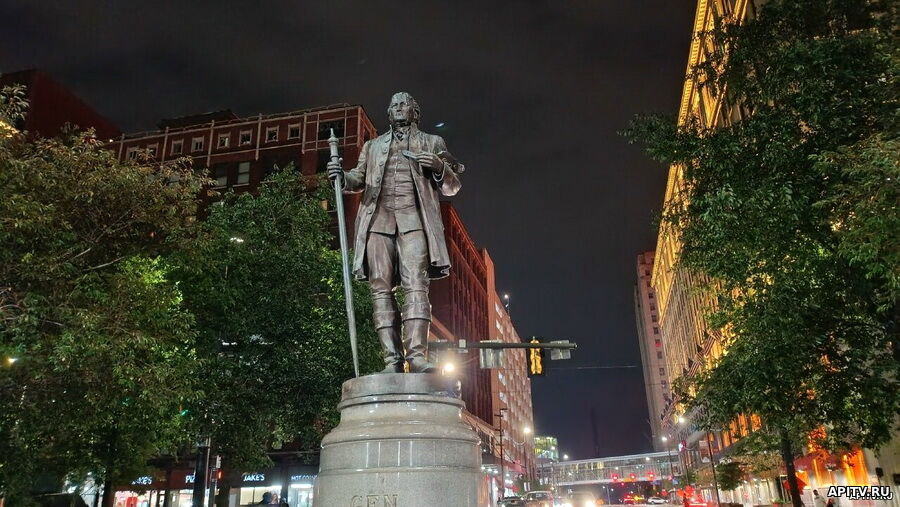
Moses Cleaveland — the founder of this industrial giant — merged in my mind with The Man of Law from Geoffrey Chaucer's The Canterbury Tales. Moses Cleaveland was a man of law born in Canterbury, Connecticut. In Chaucer's tale, the adventures of Constance at sea, her exile, and the subsequent Christianization of pagan lands play a key role. General Cleaveland's story rhymes surprisingly well with this medieval plot. The Expedition: The Path to "New Rome"In May 1796, the shareholders of the Connecticut Land Company Western Reserve turned to Moses Cleaveland. He was asked not just with drawing lines on a map, but with negotiating with Native Americans on the territory then called "New Connecticut." In June 1796, an expedition of 50 men set out from Schenectady, New York. It was a true ark: six surveyors, a doctor, a chaplain, 37 laborers, emigrants, and even two women accompanying their husbands. Some traveled overland, but the main group sailed down the Mohawk River, across Lake Ontario, and up the Niagara River, portaging their boats around the falls. The "Christianization" of the FrontierAs in The Man of Law's Tale, the path was not smooth. In Buffalo, a delegation of Mohawks and Senecas opposed the invasion. However, much like Constance buying peace with gifts, Cleaveland placated the locals with beads and whiskey worth $1,200, purchasing the right of passage. On July 22, 1796, the expedition reached the mouth of the Cuyahoga River. Cleaveland went ashore and, as a seasoned strategist, realized: this was the ideal place. The river to the west, Lake Erie to the north — a natural fortress. He divided the land into lots, and the workers named the place after him. Parallels with Chaucer
The Name's MistakeAn interesting detail: the city could have been called Cleaveland. But in 1831, the local newspaper Cleveland Advertiser dropped the "a" in the header simply because it didn't fit on the newspaper's masthead. Thus, "Cleaveland" became "Cleveland." Moses Cleaveland embodies the American lawyer-founder: a man who paved the way for an empire but remained in a quiet past, in the shadow of his medieval namesake from England. David Polyakov (Special Correspondent for API TV from Cleveland, Ohio, USA) MORE: Sherman on Fifth Avenue: Triumph and the Shadow of the Civil War Odyssey of the Rust Belt: A Visit to Barons Bus Greyhound Lines: How I Swapped a Plane for an Intercity Bus First night in New York: not on Broadway, but on Busway White Among Blacks, Rich Among Poor: Survival in One of America's Dangerous Cities JFK — Manhattan: My First Steps in the USA Rockefeller Center: The Steel Flower of the Great Depression Cleveland: Where an Empire Was Born. The Story of Standard Oil and John D. Rockefeller Akron, "All-America City 2025": One Year After the Triumph Древние люди из Сунгиря. Экспедиция Андрея Полякова «По Пути Афанасия Никитина» #ДавидПоляков #USA #Clevelend #CIP #наука #Экспедиция #АндрейПоляков #APITV #ЭкспедицияАндреяПолякова #Путешествия #Туризм #Авто | |
|
| |
| Просмотров: 14717 | |